


Key Statistics
- Household wealth fell by 0.4% ($57 billion) as of Dec. 31, 2022
- The value of residential land and dwellings is now at $9.2 trillion, down 3.9% year-on-year
- Savings accounts and superannuation saw gains despite the decline in household wealth due to falling property prices in the December quarter
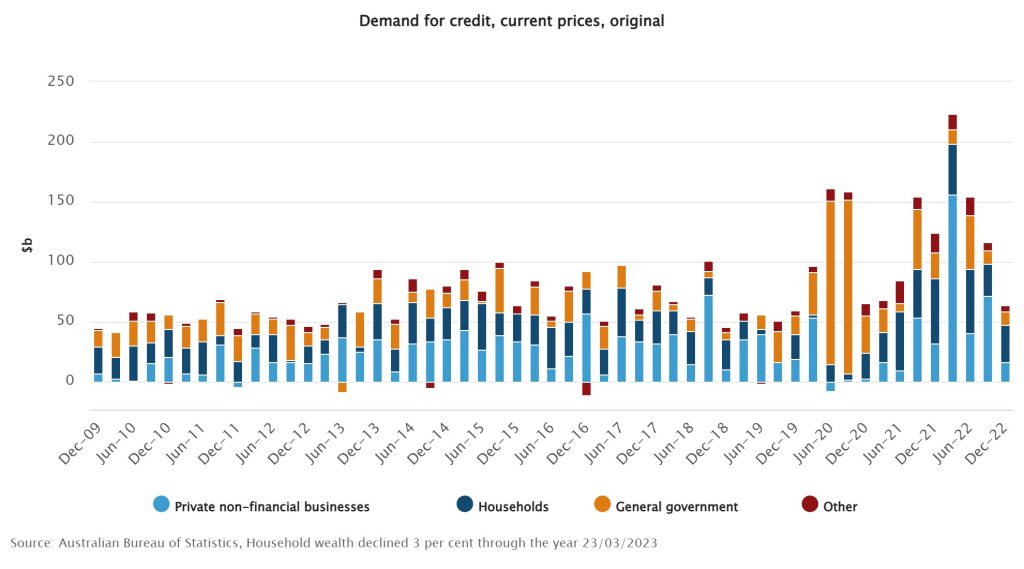
- Demand for credit dropped by over $50 billion to $63.8 billion in the December quarter, likely due to rate hikes intended to curb spending
Household Wealth Closes 2022 With a Tumble
The Australian Bureau of Statistics released figures indicating that household wealth fell for the third consecutive quarter, dropping by 0.4% ($57 billion) as of Dec. 31, 2022.
ABS Head of Finance and Wealth Statistics, Mish Tan, attributed the decline to falling residential property prices, as rising interest rates lowered demand and household borrowing capacity. The value of residential land and dwellings contributed significantly to the overall decline, dropping by 2.7% ($260 billion) in the December quarter alone.
This decline led to a decrease in household wealth by 1.8 percentage points. The value of residential land and dwellings is now at $9.2 trillion, which is 3.9% ($374 billion) lower than it was in December 2021.
Silver Lining
Despite the decline in household wealth due to falling property prices, there were some positive signs in the December quarter. Financial assets, including savings accounts and superannuation, saw gains.
Superannuation assets, however, helped to temper the quarterly fall in household wealth, rising by 3.6% ($120 billion). This was a result of domestic and international share markets rallying during the quarter, following heavy losses in previous quarters. Nonetheless, superannuation balances have lost 6.7% ($247 billion) in value since December 2021 due to declining asset prices.
Household deposits, on the other hand, increased by $32.3 billion, with a record $623.3 billion now invested in non-transferable deposit accounts such as savings and fixed-term deposits.
Tan noted that households have been investing more in term deposits as banks offer higher interest rates on these products. This increase in deposit investments may be due to banks offering higher interest rates on these products, which may have encouraged households to save more. These positive developments may help to offset some of the negative impacts of falling property prices on household wealth.
Demand for Credit Sees Decline
The December quarter saw a substantial drop in the demand for credit, falling by over $50 billion to $63.8 billion. This drop is a likely byproduct of rate hikes, which are intended to curb spending.
However, while it is important to control spending, the Reserve Bank of Australia will also need to ensure that high-interest rates do not overly constrain investment, which is essential for economic growth. Despite the decline in credit demand, national capital investment also decreased during the quarter, falling to 22.4% of GDP. This decrease in investment may indicate that the high-interest rates are indeed having a significant impact on investment activities.
